Moving Image Matters
Parsa Sanjana Sajid, 2026
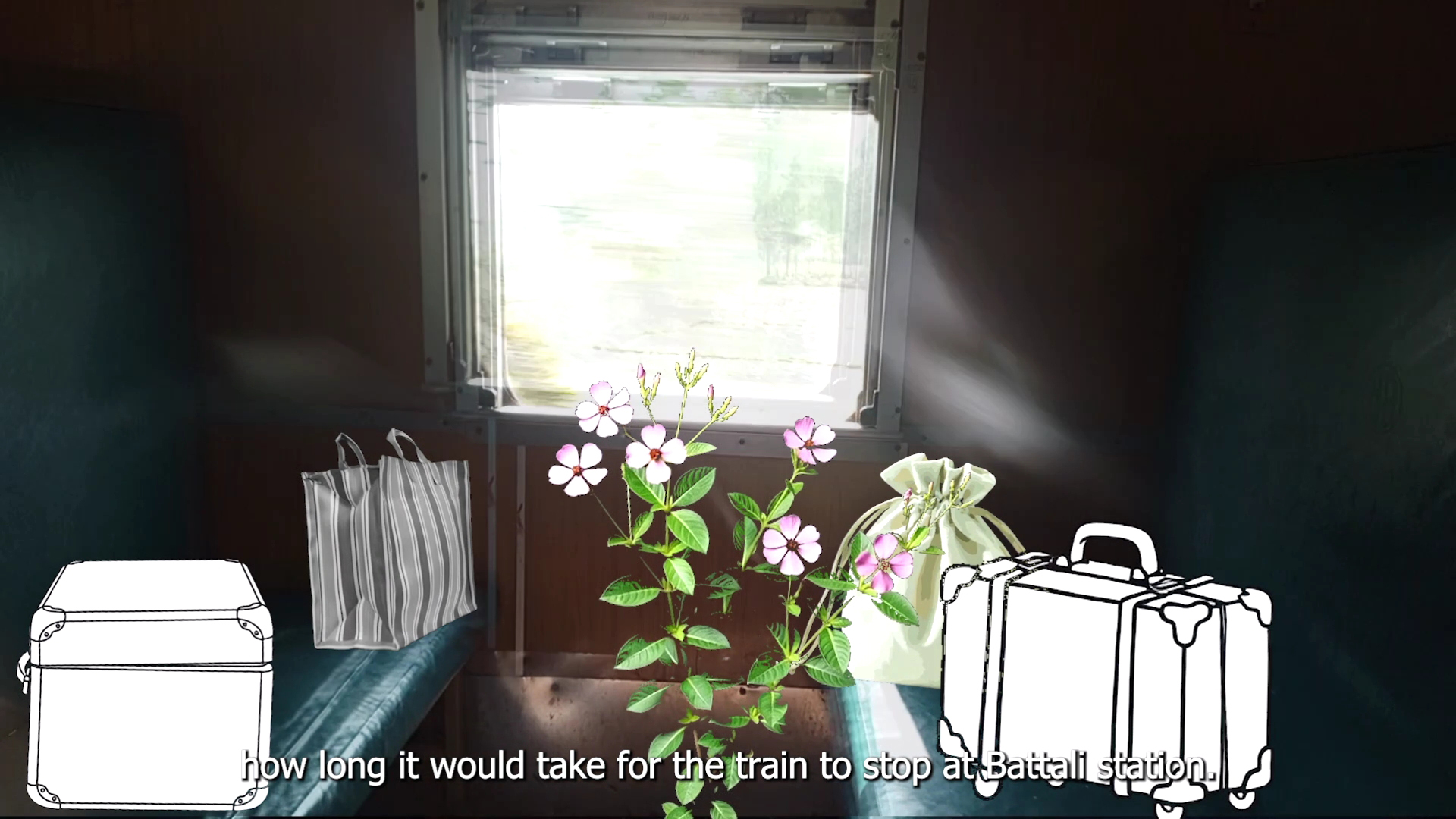 Door, 2025, Moving Image By Palash Bhattacharjee, Photo © Artist
The ubiquity of images and their status as a fundamental discursive instrument began with the popularity of photography and cinema and has now roiled through much of our late-modern era. Rapid digitization and technological insertions into everyday life laid the groundwork for image-dependent attention economies. Image ceased to be merely representative or symbolic a while ago and now actively produces and constructs a sense and understanding of reality and even structures the real. Without getting into a deliberation on blurred lines between reality and illusion, image making in the twentieth and twenty-first centuries has merged signs with meaning, has led to a proliferation of context collapse (memes are a good example), and has rewired consciousness to produce newer patterns of cognition, recognition, and subjectivities. This moment hasn’t arrived arbitrarily but by a fusion of capitalist developments, technological accelerations, and radical transformations of social and material relations. The heterogenous artistic and creative forms which we understand as moving image and video art – as well as new media – emerged from these advances, and at times, encroachments.
In “Working Terms: ‘Moving Image’ History and Distribution” (2014) Mason Leaver-Yap, Sheryl Mousley, and Fionn Meade appropriately offer an anti-definition that “moving image is clearly still a term that’s up-for-grabs,” a term “that’s being revised and negotiated because it has more currency at the moment.” Most theorists, practitioners, and art historians including Leaver-Yap et al., trace the development of the field in contrast to “cinematic conventions” circa 1960s when artists began to move “out from cinema into the space of the gallery [or other non-theatrical, non-gallery alternative spaces], which is really where the moving image becomes a functional term.” “If movement is an illusion,” as they argue, then moving image in its technical form, style and enactment foregrounds the experimental and improvisational nature of the craft and movement much more directly. Did it break the illusion by baring the cut-paste-sampling-editing in a more obvious fashion, by shifting the viewing experience with installations as integral to the form, or create another form of illusion, another bargain with the image-form itself? Leaver-Yap, Mousley, and Meade characterize it as “the beginning [from the 1960s] of intermedia, […] the beginning of expanded cinema. Essentially, it’s the spatialization of a temporal form.”
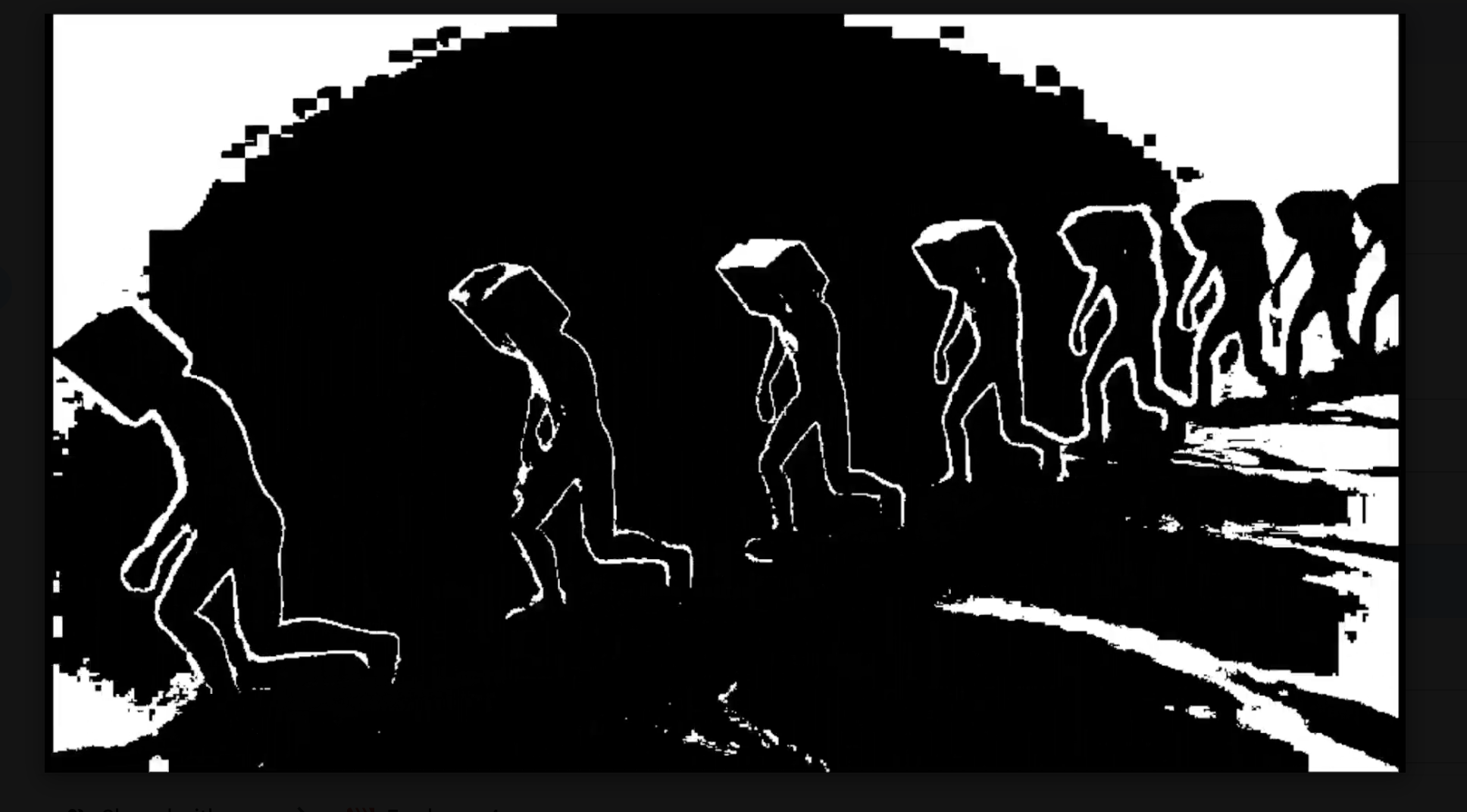
Erode (screengrabs), 2024, Moving Image by Mong Mong Shay. Photo © Artist
Derived from and combining both photographic and motion picture conventions, but going further or subverting and deviating from both, the image in moving image contrives a language relatively less dedicated to linear narrativization or expression. In technique, more comfortable with genre bending, blending the familiar with the unusual, chopped-up edits, found footage, reappropriations, moving image leans toward dis-order, manufacture and manipulation with craft at forefront. Improvisation as narrative and technical device often highlights the material dimensions of moving images. A format always on the cusp of the hyperreal and the speculative, because how it’s put together often takes front seat, the maneuver of it made visible, while that same device rearranges and scrambles its temporal, spatial and narrative elements into conceptual abstractions.
In Zihan Karim’s Eye (1) (2014), which I first encountered at the 2016 edition of Dhaka Art Summit, a large convex disk with an iris-like center rotated scenes of nature into charred terrains as the audience watched – if they cared to watch – as literal bystanders. We watched, as the screen - itself an eye - watched us back (or over us?). Stare long enough and the center would appear as a vortex, an impenetrable middle around which spun landscapes of abundance transformed into ruination. Stare even more and it would be the center as a force field regulating the motion in its orbit and into which everything disappeared – a black hole of no image and no movement, dissipating time, scale, momentum. Karim, who is from the port city of Chittagong, and was educated at the Institute of Fine Arts, University of Chittagong (IFA-CU), where he now teaches, has credited the city’s ecological bearing – buttressed by the hills and the Bay of Bengal – with informing his work. Perhaps that transitional, border-adjacent landscape, an unsettling location, a station of arrival, departure, occupation, and disturbance found its way into the visual code of moving image with Karim the observer and artist as its medium.
An adjustment of time, perspective, and orientation is manifest in moving images that invites a similar engagement from the viewer, who must return the gaze and commitment to the work, if not in equivalent measure, then in sentiment. Another IFA-CU faculty member, Shohrab Jahan, who integrates moving image into his work, thinks the terms of exchange with the audience are a negotiation between the tangible and intangible, since a scripted time does not direct the encounter unlike in cinema, allowing viewers to stretch or condense time, making their commitment to a work more supple (Jahan, Shohrab. Interview. Conducted by Parsa Sanjana Sajid, June 2026). Less prescriptive than theatrical viewing experiences, Jahan contends that the audience could choose the time they spent with a piece, whether to watch in full or in fragments, to return to it or repeat it, giving them more space to negotiate with moving images. This temporal elasticity and more time to play is permission for reflection on a different plane, and, in Jahan’s words there’s a simultaneous communion and confrontation with/between the khudro (miniscule) and the oshim (infinite). Open or enclosed, every space is conditional and the walled space of a gallery and museum has its own limitations, but the “contingency of the gallery [can present] a renewed opportunity to engage with, critique, interact with or dematerialise the space,” when compared to movie viewing. On the other hand, an environment like the cinema which expects an audience to commit in entirety, could be the more defiant move against our dwindling attention spans.
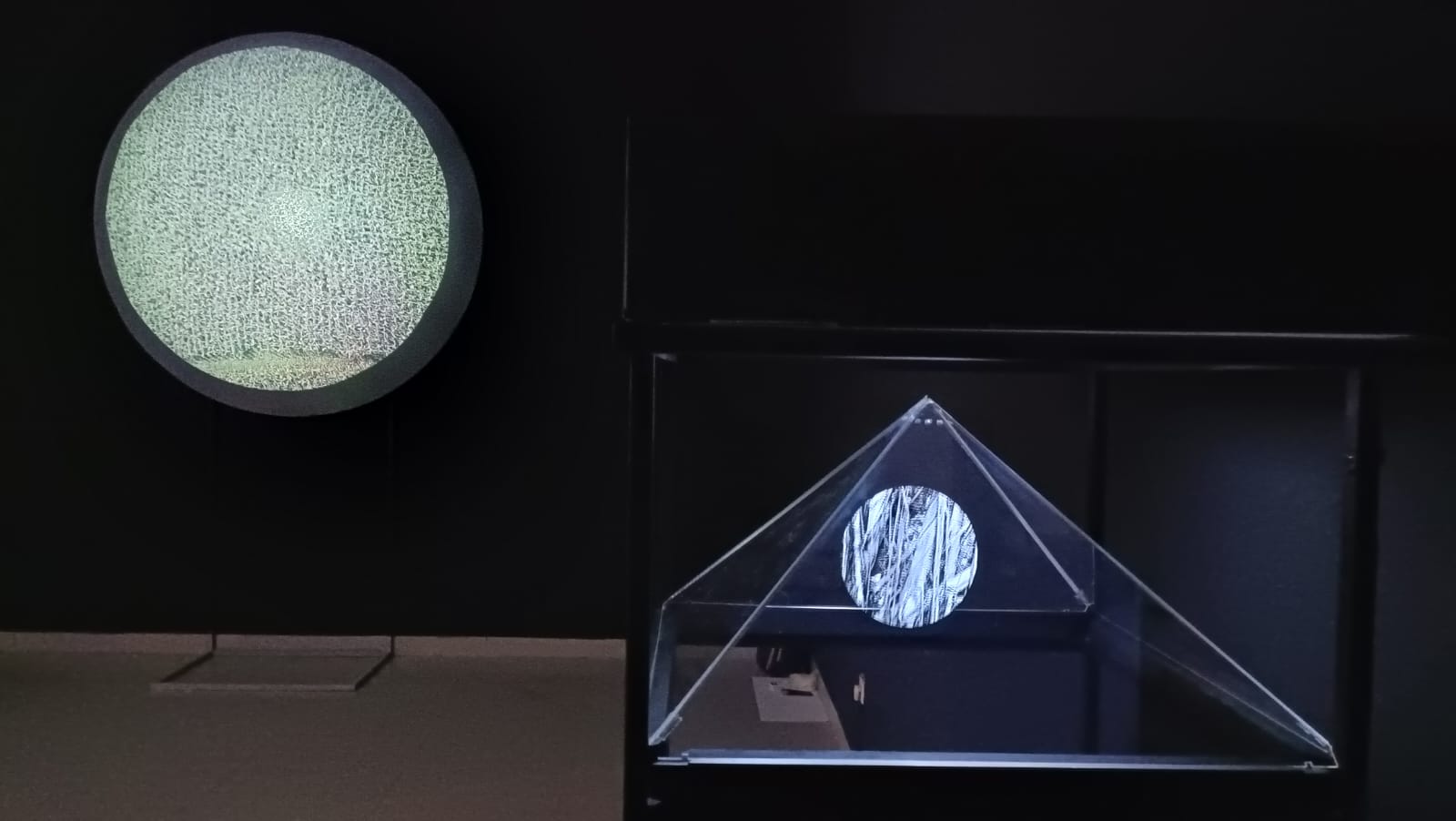
Eye(II), 2024 By Zihan Karim; Loop Video With Audio, 11.00 Min; Installation View: Colomboscope 2024; Photo © Ruvin De Silva
In Bangladesh, performance art with its durational element and a flourishing new media scene since the 1990s are precursors to moving image practices in which Chittagong also emerges as a point of interest. The artist Palash Bhattacharjee, who is currently based in Chittagong and in whose multimedia works screens are often a principal mediator, argues that a relative absence of commercial and commissioned opportunities in Chittagong, in contrast to Dhaka, channeled artistic expressions into a more experimental, versatile practice and cross-disciplinary ethos (Bhattacharjee, Palash. Interview. Conducted by Parsa Sanjana Sajid, May 2026). In Dhaka, when the Zainul Abedin-established Faculty of Fine Arts at Dhaka University (FFA-DU) which is still the premiere public arts institution of the country, kept its curriculum and pedagogical approach unaltered against an evolving scenario of market liberalization of the 1990s, introduction of the internet and digital media, access to technology and a crop of artists more exposed to international developments, artist-run spaces like Britto Arts Trust and private institutions such as Pathshala South Asian Media Institute created platforms for more open-ended, cross- and new media-based practices. Critic, curator and artist Mustafa Zaman, who trained at Dhaka University, also recalls an extra-institutional and self-motivated drive around that time to produce and experiment with collage, cutouts, overlays using fax, photocopier, old, discarded bootleg magazines and objects, a spirit of aggregation and combination, all of which later heralded new media, video art, installation and moving image as methods of expanding artistic boundaries.
Among the public institutions, however, Chittagong stood out. Artists like Bhattacharjee and Jahan acknowledge the leading roles of IFA-CU founding faculty such as Rashid Chowdhury, Dhali Al Mamoon, Alak Roy, themselves artists, and the art historian Abul Mansur, in encouraging and sustaining an interest in interdisciplinary pedagogy which proved pivotal in the early years of the institution. Although the institute’s departments were conventional, it also accommodated theoretical instruction and an interdisciplinary program encouraging students beyond medium fidelity. Short of calling it a fully integrated curriculum or pedagogical design, Jahan characterizes it as a “warmup” and a cultivation of a certain level of “chaos,” loosening mediums (e.g., sculpture, painting) and students coaching them from territorial thinking towards more wandering sensibilities.
Outside of the institute’s confines, this same crop of artists, Bhattacharjee, Jahan, Karim among them, initiated alternative collectives like Pora Para and Jog Art Space to nurture similar philosophical affinities. Innovative, multi-year, open-ended enquires - like the Cheragi Art Show, a Britto workshop spearheaded by Mahbubur Rahman in Chittagong, which increased exchanges between artists in Chittagong and Dhaka and beyond, including with East Asia, and the scorching performances of Joydeb Roaja (of Hill Artist Group’s and also of Pora Para), fed a tinkering thirst in curious minds, developed their interest in moving image further and established Chittagong as a wellspring of activities. That moving image is hard to define became part of its appeal in an art scene grasping for a break from the constraints of legacy institutions. In the workshops, street art and artist collectives, Jahan told me, the student-faculty dynamic was less rigid; even faculty members stubborn about maintaining discipline-integrity within institutions like the IFA-CU were enthusiastic participants in those alternative spaces and exercises, appreciating the value of experimentation there. A tapestry of influences, references, unrestricted explorations, timing, luck and market as one would have it, formed the bedrock of what became a budding artistic field. When Bhattacharjee says, “the camera is our canvas,” he speaks more of a native language than a tool, a code which forms thinking rather than just an accessory. An alumnus of the Dhaka University’s FFA and a multimedia artist, Mong Mong Shay, suggests the faculty at Chittagong University have so far managed to interest and influence successive generation of students in new media and moving image with their own practice, still absent in his alma mater (Shay, Mong Mong. Interview. Conducted by Parsa Sanjana Sajid, June 2026).
In the ensuing years, artistic practices in Bangladesh responded to and were reshaped by the local, regional, international circuits with Chobi Mela and Dhaka Art Summit as significant conduits of encounter and exhibition. Tailored from a rigid public pedagogical setting as well as a burgeoning and receptive international circuit, née market, moving image in/as contemporary art here is much closer to concurrent bargains and negotiations with multiple orthodoxies and institutional limits and reach. Although neither tradition, market, nor habit are stable enough to deploy meaningfully, what is understood by each were fused for the practice to catch on among artists working against less adaptive public institutions but adapting to and developing counter spaces, private ventures and global market demands. In no small part, a diaristic trend incentivizing documentation and the availability of the means of image production and circulation also paved the way for moving image to enter the lexicon of visual expression and contemporary art.
Bhattacharjee, who recently showed Door (2025) in the Begum Rokeya-inspired exhibition at the Liberation War Museum jointly organized with Kalakendra (December 2025 – March 2026), usually takes a meditative route, delivering macro narratives via micro recitations. In the multimedia, multi-channel installation Door, the unsung sphere of women’s worldbuilding in their ordinary routines materializes out of a memoiresque homage to his own roots, particularly to his grandmother, and out of a memory of the women’s daily lives in the region he grew up in. Stylistically on a different spectrum, Mong Mong Shay’s post-July uprising Erode (2024) is a ramble of swirling silhouettes – bodies and body parts, figures and waves – with a circular center and syncopated rhythm, an attempt to convey the chaos and its psychic register of the time. From the languorous poeticism of Bhattacharjee’s works to absurdist digressions in some of Shay’s videos, artists display a heterogenous stylistic range, but arguably a pattern of social commentary and awareness as affect is noticeable in many of these works. Women’s positions, trauma and distress, climate crisis, and more are subjects of sentimental awareness and private ruminations. The personal is political, but can the political be personalized in innocence? The artist teaches, but are they ever implicated? That affect of awareness I refer to is often self-exculpatory, with the artist at its moral center, unlike the Barthesian death of the author. Tonally they signal a conscious or mindful ‘voice’ with social sensibilities, but risk no material entanglements with their subjects, locating the problems as removed from any artistic agency. That way, the artist can be both present and absent at their convenience.
Less prominent in many of these works is what the literary theorist Sianne Ngai calls “ugly feelings,” sentiments like envy, anger, paranoia, irritation, and anxiety which are also ripe for social commentary, critical, and structural interrogation. Writing about envy, for example, she reflects that:
“Moralized and uglified to such an extent that it becomes shameful to the subject who experiences it, envy also becomes stripped of its potential critical agency—as an ability to recognize, and antagonistically respond to, potentially real and institutionalized forms of inequality. It is impossible to divorce the pervasive ignobility of this feeling from its class associations or from its feminization, which might explain why the envious subject is so frequently suspected of being hysterical.” (Ngai, Sianne. Ugly Feelings. Harvard University Press, 2007)
Disgust, offense, taste or distaste: our aesthetic judgements are not simply matters of personal choice. So then – what image of self, society and systems are in a constant loop of production and circulation and what goes missing? Can any artistic expression, including moving image, recuse itself from one’s own mess, especially the political and material baggage of the processes of production? Is it enough to gesture towards an issue, since so many of the works deal with issues, and house the problems in an indistinct sense of society, without the latter’s institutional entrails? And the “ugly feelings,” where do they reside?
We are at a moment when images are everywhere. Returning to “Working Terms,” the speakers point out that “we’re editing moving images ourselves, and the editorial thinking of the moving image is becoming a bigger part of daily life.” And in Shay’s words, “everything is moving image.” But despite the omnipresence of images, we are at a precipice because “the image refuses to stay still long enough to be fixed as an object. At the same time” with the saturation of “data and audiovisual media [of] everyday life and the consumption of images [as] an almost inevitable condition of capitalist society,” the condition of truth is degrading at a faster pace.
And when image and truth become coterminous, what philosophies of image or moving image can artists offer at that juncture?
Parsa Sanjana Sajid
2026
Note: I am grateful to the artists Mong Mong Shay, Palash Bhattacharjee, and Shohrab Jahan for their time and insight; all were interviewed for the purposes of this piece. And to the critic and artist Mustafa Zaman for multiple conversations over the years, though he was not specifically interviewed for this essay.
About the writer:
Parsa Sanjana Sajid is a writer, curator, and cultural worker based in Dhaka, Bangladesh with cross-disciplinary interests spanning social spaces and movements, migration, gender justice, literary, digital, and visual culture. Learn more about her work here.